The pain 2 min read
You know how this goes. Your team briefs the agency on a new batch of video ads. They come back four weeks later with a polished creative. You launch. The first two weeks look good. By week four the click-through is dropping. By week six the cost-per-lead has doubled. By week eight you're scrapping the batch and starting over.
Meanwhile your AdWords lead's calendar is blocked off three days a week reviewing creative iterations. Your CMO is asking why ad spend is up and pipeline isn't. Your founder is wondering out loud why static image ads from 2019 still work and these video ads don't.
This is the rhythm most B2B SaaS marketing teams live in. Replace creative every 30 days. Burn through retainer hours on iterations. Watch durable ROAS slip away.
I shoot B2B video for a living. Over 1,000 videos for 250+ B2B brands. The pattern is the same every time someone walks into the discovery call frustrated about ads. The ad isn't the problem. The funnel behind the ad is. And the fix is a system, not a creative.
Why most B2B video ads fail 2 min read
Three failure modes repeat in almost every brief I see.
One: the ad has no funnel behind it. A single video ad gets briefed, shot, launched. There's no retargeting variation behind it. There's no VSL on the landing page. There's no confirmation video at the booking step. The ad runs alone, audiences saturate, performance falls off a cliff. This is the dominant pattern.
Two: the on-screen face is wrong (or missing). A lot of teams show motion graphics with a voiceover, or worse, an AI avatar. B2B buyers can clock an AI avatar in two seconds[1]. Your audience scrolls past faceless ads and they pause for human ones. Buyers are buying from people, even when the brand wants them to buy from the brand. So if you're spending real money to get views and there's no human, you're paying for impressions that don't compound trust.
Three: most teams quit before the math turns. They run a batch. The batch dies. They decide video doesn't work for their audience and they go back to static. The teams that win don't quit. They build the system once and let it pay back across six months. The teams that lose chase a new creative idea every week.
The 5-1-1 framework, in plain English 2 min read
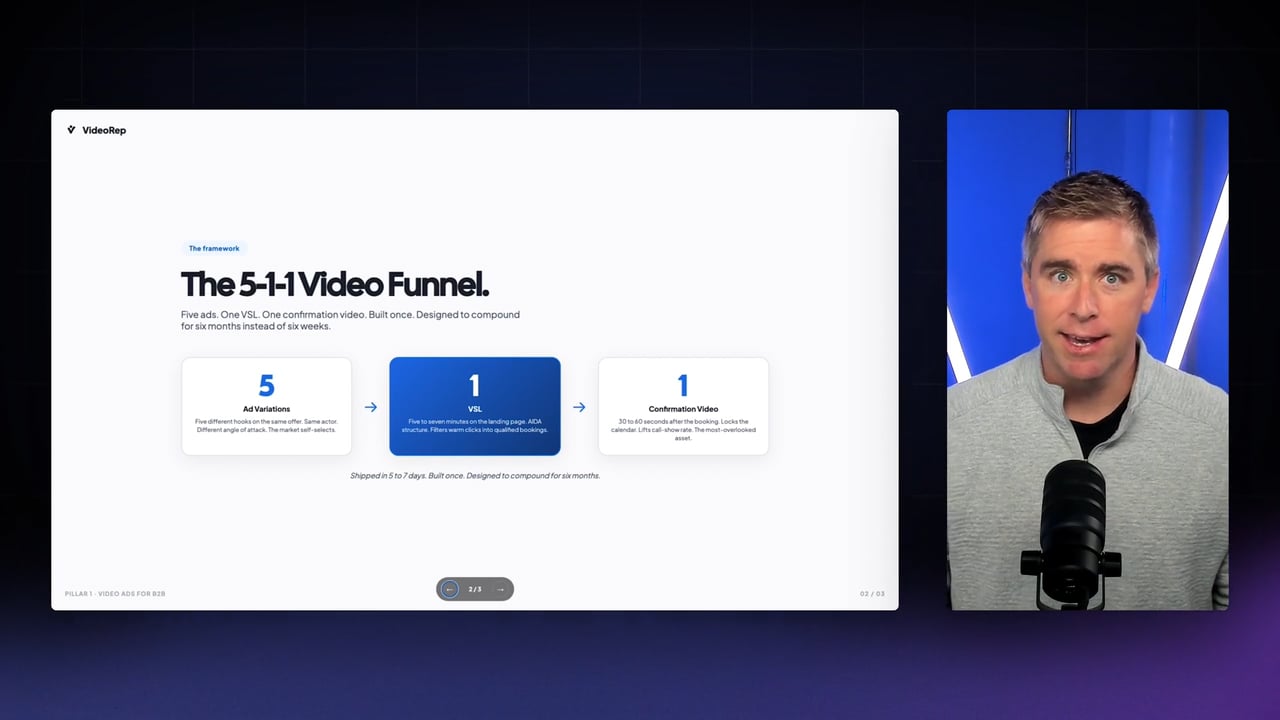
The 5-1-1 Video Funnel is seven assets that work together. Five video ads with five different hooks pointing at five different pain points. One Video Sales Letter on the landing page. One confirmation video at the booking step.
We didn't pick five hooks because it sounded clever. We started with three. Tested it. The data showed B2B buyers split across multiple pain entry points, not just one. So we expanded to four. Tested again. Still leaving conversions on the table because some pain points were getting two ads and others got none. So we landed on five. Five hook variations on the same offer, the same actor, the same production. Different angle of attack each time.
The ads do their job at the top: capture attention, qualify quickly, push warm clicks toward the landing page. The VSL on the landing page does its job in the middle: agitate the pain, articulate the solution, hand over proof, and ask for the call. The confirmation video does its job at the bottom: lock the calendar booking, set expectations, hand off to the sales call with the prospect already prepared.
Most teams build one or two of these three. The teams that win build all three.
The 5 retargeting ads 3 min read
The five ads share everything except the hook. Same actor. Same offer. Same production budget. Same length, typically 30 to 60 seconds. What changes is the first three to five seconds of each ad: a different pain point, agitated a different way, opening into the same offer.
A pain that lands at week one for one buyer might land at week six for another. By running five hook variations in rotation, you're letting the audience self-select. The buyer hits the ad whose pain is THEIR pain, and the rest of the variations live behind it as the retargeting pool.
The hook patterns I keep coming back to:
- "If you're [persona] and [specific symptom is happening], here's what's actually going on."
- "Most B2B [persona] don't realize [counterintuitive insight]."
- "I've shot 1,000+ B2B videos and here's the one thing that keeps killing your ads."
- "Your CFO asked why ad spend is up and pipeline isn't. Here's the honest answer."
- "We worked with [class of company] who tried [common solution] for six months. Here's what we did instead."
Each hook is two beats. Name the pain or the persona, then promise an unexpected reveal. Three to five seconds, no fluff. The brand mark sits on screen by second five so any unfinished view still leaves a brand impression.
We export every ad in vertical, square, and landscape. Same edit, three crop variants. That covers Meta feed, LinkedIn feed, YouTube in-stream, and Stories or Reels placements without back-and-forth with the editor for a re-export.
Eric walks through the 5 hook patterns on camera
Coming with v2 of this article. Fill slot when filmed.The 1 VSL 3 min read
The VSL on the landing page is the asset that converts. It's also the asset most B2B SaaS teams either skip or ship a 90-second version that doesn't qualify the buyer enough.
I default to AIDA over PAS for B2B VSLs. Attention, Interest, Desire, Action. Problem-Agitate-Solve is great for short-form retargeting because it's tight and direct, but PAS doesn't give you space to tell a story, hand over real proof, or address the four or five objections a B2B buyer arrives with. AIDA gives you that space.
A working B2B VSL hits these beats in order:
- Hook the lean-in. They just clicked an ad. Acknowledge what brought them here.
- Name the pain in their words. Use language that sounds like what they'd say on a sales call.
- Agitate the cost of doing nothing. What does it cost their business if this stays broken for another quarter?
- Reveal the solution. Concrete. Specific. Not vague.
- Hand over the proof. Real client names where allowed. Real numbers. Durability beats flash.
- Address the four or five objections. Pricing range, timeline, what if it doesn't work, what's the commitment.
- The ask. One specific next step. Book the strategy call.
Length is the question I get more than any other. The honest answer is five to seven minutes. Long enough to qualify, short enough to convert. The buyers who watch all the way through are the buyers worth getting on a call with.
The 1 confirmation video 2 min read
This is the most-overlooked asset in B2B video, and the one with the cleanest ROI math.
A confirmation video runs immediately after a prospect books a call. It's 30 to 60 seconds of you (or your presenter) addressing them by name, confirming the booking, and setting expectations for what happens on the call.
What it actually does:
- Locks the calendar booking. Show-up rates on first calls go up materially when the prospect has already seen the human face they're meeting with.
- Sets expectations. "Here's what to bring, here's what we'll cover, here's what the next step looks like if it's a fit." Prospects show up prepared, sales calls are tighter, conversion improves.
- Transfers trust from the booking page to the call. They've seen you, they've heard you, you're already real to them before the call starts.
We shoot the confirmation video once and use it forever. One asset, forever automated, lifts call-show rates and call-quality with no ongoing labor.
There's a bonus version of this. Marcus Sheridan's "80% video," answering the top frequently asked questions a sales rep hears[2]. Run that as the second video in the post-booking sequence and your sales calls skip the qualification dance and go straight to the close conversation.
The proof 2 min read
Three quick walkthroughs of how the 5-1-1 system played out in real client engagements.
BusinessLoans.com. They came to us wanting one specific video done. We shipped one inside the 5-1-1 architecture and ran it as a test. Six months later it was still serving and still profitable. Their previous video projects ran one month and got swapped. This one ran for six. It became their highest-grossing single piece of paid creative ever.
A boutique financial advisory. We built the system. They launched. Within a few months they had to turn it off. Not because performance dropped. Because they were getting more leads than their team could handle. The VSL on the landing page ran seven months without revision. The retargeting ads compounded. They paused the spend, not us.
Fyntra. Four videos in 48 hours. 4X leads in 7 days. The math is in the speed: a tight 5-1-1 system shipped fast lets a paid team test creative variations against real spend without waiting six weeks for an agency revision cycle.
How long this takes and what it costs
The standard 5-1-1 funnel ships in five to seven days end-to-end. Day one is the strategy call and brief. Days two and three are scripting and prep. Days four and five are filming. Days five through seven are editing, exports across formats, and delivery of all seven assets.
Individual ads ship faster: 48 hours to 7 days depending on scope. Enterprise scale work like Unilever's case (14 videos in 2 weeks, $25K saved versus their previous agency arrangement) is a documented precedent.
Pricing is a conversation we have on the strategy call, not a public number. Every engagement looks different. Some teams need the full 5-1-1 once and a quarterly refresh. Others need ongoing presenter capacity inside their content engine. The price reflects the scope, not a productized tier on a sales page.
Here's what I will say publicly. The floor is lower than most B2B SaaS teams expect. The ceiling is well below what a $10K-to-$24K monthly retainer at a faceless agency runs. The performance guarantee is the same on every engagement. I stay until your video outperforms your best static ad on click-through rate. No time limit. No extra charge.
Want to see if 5-1-1 fits your team?
Book a free 30-minute strategy call. We'll walk through your current funnel, where the leaks are, and whether 5-1-1 fits before either of us spends another hour on it.
Book a Free Strategy CallFAQ
How is this different from hiring a freelancer on Upwork?
How is this different from a faceless agency like Videodeck?
What if our founder won't get on camera?
Can we get the raw footage or project files?
Is there AI in the videos?
- "AI talking head videos" thread, r/marketing, retrieved 2026-05-05. Verbatim audience quotes "Synthesia vibes" and "people clock it in two seconds." See r/marketing/1gd1whh and aggregated audience research at videorep.co/research/audience-questions-reddit-quora.
- Marcus Sheridan, "The 80% Video" methodology and post-booking video sequence research. Reference book: The Visual Sale (Sheridan and Lessard, 2020). See marcussheridan.com.
- Internal client engagement data: BusinessLoans.com (2024-2025, 6+ months sustained ROAS on a single ad), boutique financial advisory (NDA, 2023, 7+ months durable), Fyntra (2024, 4X leads in 7 days from 4 videos), Electric Heroes (2024, 22 ad variations / 3X sustained ROAS), Unilever (2024, 14 videos in 2 weeks). Sources verified in `videorep/positioning.md` v6 section 10 and the canonical client roster.
- Industry benchmarks on B2B social ad fatigue: ad refresh cycles of 3 to 8 weeks on social channels are standard. See ADsmith Marketing, "Ad Fatigue: How Long is Too Long"; Pathlabs, "Creative Fatigue".
- B2B SaaS landing page video conversion lift: video on a landing page increases conversion rates by approximately 86%. See Flint Studio, "25 Landing Page Conversion Rate Statistics for B2B SaaS Companies".